Saturday, 3 November 2018

Blackmore. Remembrance 100. Twenty-one days. Twenty-one names. (3) Edwin Alexander

Edwin Alexander
War Memorial: Place and inscription
Blackmore War Memorial: A/B E. Alexander RN
St Laurence Blackmore Window:  Edwin Alexander
Ongar & District War Memorial Hospital Roll of Honour (Blackmore) [ERO A10815]
Rank:
Able Seaman
Regiment:
H.M. Submarine "E36".  Service No:J/12975 [CWGC]
Service Details:
-
Personal and family information:
Foster son of Emma Bass, of Vine Cottage, Blackmore, Ingatestone, Essex. [CWGC]
Little is known about Edwin Alexander. The most local Birth is Sep 1895. Alexander Edwin James. Hackney. 1b 540. [statutory register]
1901 Census: Emma Bass (aged 44, born Radwinter), foster mother to Edwin Alexander, is recorded as living in ‘Cottage’ somewhere near to the Post Office in Blackmore village.  She was married to Jabez Bass (aged 54, born Little Dunmow) and at that time had two foster children: Horton Wright (age 7, born Blackmore) and Dora Lynn (age 1, born London).
Emma Bass, Chelmsford Road, was baptised as an adult at The Baptist Church, Blackmore, on 31st May 1896 and received into membership the following week [ERO T/B 324/1].
Emma Bass listed as voter (for the first time) in the Electoral Register for Blackmore in 1918.  Emma recorded as living in ‘The Village’. Other Bass named is Jabez (husband). [ERO C/E 2/1/1].
It is not clear whether the fostering arrangement implied any relationship to Edwin Alexander.
Date of Death:
19th January 1917 [CWGC]
Age:
23
Where died:
HMS E36 was sunk in a collision with HMS E43 off Harwich in the North Sea. There were no survivors.
Place of Burial or Commemoration:
Memorial: Chatham Naval Memorial. Grave No: 21 [CWGC]
List of Sources:
Commonwealth War Graves Commission, Essex Record Office,

Mrs Bass

Friday, 2 November 2018

Blackmore. Remembrance 100. Twenty-one days. Twenty-one names. (2) Walter Brazier

Walter Brazier
War Memorial: Place and inscription
Blackmore War Memorial: Stoker W Brazier R.N.
Church Window: Walter Brazier
Ongar & District War Memorial Hospital Roll of Honour (Blackmore) [ERO A10815]
Rank:
Stoker
Regiment:
1st Class Royal Navy.  H.M.S. "Laertes.".  Service No: 311704 [CWGC]
Service Details:
-
Personal and family information:
Walter Brazier’s name appears in the St Laurence, Blackmore ‘Sunday School Admission Register’ with “age” recorded as “19/11/85”.  [ERO D/P 266/28]

Walter Brazier was born in Highwood in 1885/6, the son of Walter and Sarah Brazier.
The following parish registers were checked for a baptism without success: Blackmore, Highwood, Roxwell, Writtle, Mountnessing.

1901 Census.
Fingrith Hall Road, Blackmore
Walter Brazier. Head. Married. [Age] 40. [Occupation] Pitman (gravel). [Born] Chelmsford
Sarah Brazier.  Wife. Married. [Age] 39. [Born] Ingrave
Walter Brazier.  Son.  [Age] 15.  [Born]: Highwood
Florence Brazier.  Dau.  [Age] 11.  [Born] Mountnessing
Mary Brazier.  Dau.  [Age] 9.  [Born] Blackmore
Samuel Brazier.  Son.  [Age] 6.  [Born] Blackmore
Joseph Brazier.  Son  [Age] 3.  [Born] Blackmore
Laura Brazier.  Dau.  [Age] 1.  [Born] Blackmore

1914 Electoral Roll. Walter Brazier recorded as living at “High house” [ERO C/E 1/2/26]
Florence Brazier married Ernest John Wager, named as one who served on the War Memorial.  Likewise Samuel Brazier, who returned. [Barbara Dawes, 3.11.18]
Date of Death:
28th August 1914 [CWGC}
Age:
29
Where died:
Laertes became part of the 3rd destroyer flotilla based at Harwich.  She took part in the Battle of Heligoland Bight on 28th August 1914, where she was seriously damaged suffering four shell strikes. The most serious struck the boiler room, killing Walter Brazier and one other, temporarily cutting off all steam supplies to the engines and leaving the ship motionless. Another shot destroyed the middle funnel, while a gun was also hit. The ship managed to restore some power but had to be towed back to England.
Place of Burial or Commemoration:
Memorial Reference: R.N. Plot. 5. Cemetery: Shotley (St. Mary) Churchyard
List of Sources:
Commonwealth War Graves Commission, Essex Record Office.

Barbara Dawes wrote on the Blackmore Memories Facebook page: "My gt-uncle, his sister Florence was my Nan. He actually died on the first day of the very first naval battle of WW1, which somehow seems even more tragic, hardly had a chance to serve. What a waste."

Thursday, 1 November 2018

Blackmore. Poppy Display and Trail - Work In Progress

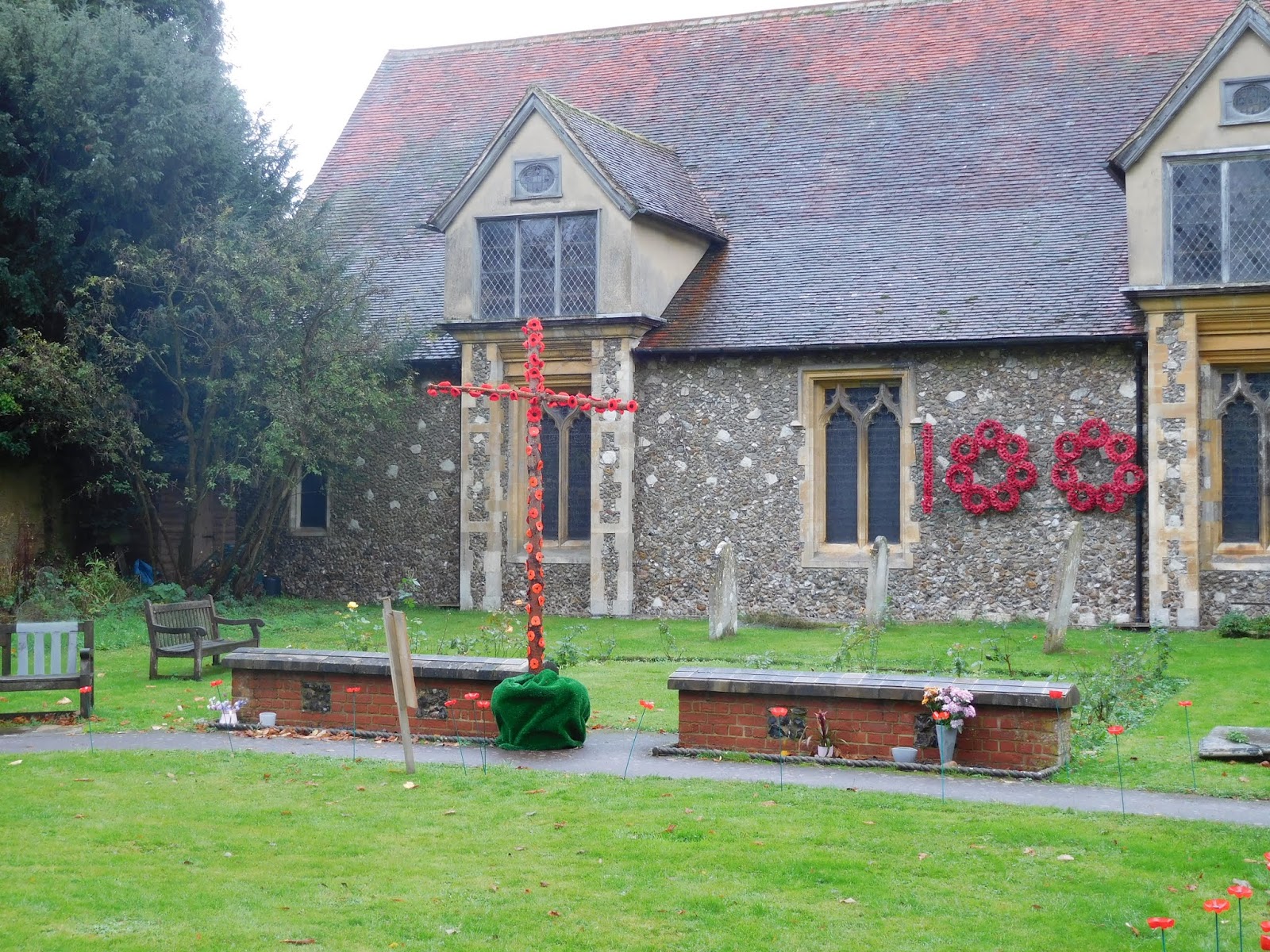
Photographs taken today of work in progress installing Poppy Trail and Display at Priory Church of St Laurence.  Part of Remembrance 100 commemoration of the end of the First World War.  Available to see until 21 November 2018.


Blackmore. Remembrance 100. Twenty-one days. Twenty-one names. (1) Ian A Miller

Ian A Miller (or Millar)
War Memorial: Place and inscription
Blackmore War Memorial: Sec Lieut A. I. Miller M.M. R.I.R.
Church window: 2nd Lt Ian Miller
Ongar & District War Memorial Hospital Roll of Honour (Blackmore) as I Miller [ERO A10815]
Commemorated at Appledore, Kent
Rank:
Second Lieutenant
Regiment:
Lieutenant Royal Irish Rifles.  6th Battalion [CWGC].
Service Details:
Medal card: E Kent M Rif Pte 1522
R Ire Rif Sec Lt Capt dec’d 30/9/16.
Victory/British ø off 59 15e
15 Star ø off 59 25                 IVXd/1711 22 NW/7/18358
First theatre Gallipoli 7/7/15
Contact Mrs Jenkins, Ardmore, Appledore, Kent. [Ancestry.com]

The Struma River flows through Bulgaria southward to the Greek frontier, then south-east into the Aegean Sea. From the Allied base at Salonika, a road ran north-east across the river to Seres, and it was this road that the right wing of the Allied army used for the movements of troops and supplies to the Struma front during the Salonika Campaign.

The Salonika Force arrived in 1915, and dug-in until the summer of 1916, by which time the international force had been reinforced and joined by Serbian, Russian and Italian units. The Bulgarian attempt at invasion of Greece in July was repulsed near Lake Doiran. At the beginning of Oct 1916, the British in co-operation with her allies on other parts of the front, began operations on the River Struma towards Serres. The campaign was successful with the capture of the Rupell Pass and advances to within a few miles of Serres.  Ian Millar died in the operations in the Struma valley and the capture of Jenikoj.

Quote from diary of David Campbell, MC: In our sector the main attack was carried out by the 37th Division and our Battalion was allotted the task of guarding their left flank.  We crossed the Struma at dawn (It having been bridged in the meantime by the R.E’s) and at first met with little opposition.  Then the company on my right came under fire and their advance was checked.  My company was sheltering under a high bank and our Second in Command Major Graham, who happened to be with me, would not let me proceed further until we made an effort to subdue the hostile fire.  There was a field of all mealies on my left front but straight ahead of me the ground was clear.  I had a company of machine guns with me so we first got them to rake the mealies with their fire.  By then, I had climbed to the top of the bank and through my field glasses I spotted the sniping post that was causing the trouble.  In a matter of seconds, I had the machine guns on to it and was watching their fire, from the strike of the bullets, converging on the spot. 

There was no more fire from that post and we were able to continue our advance unimpeded.  But we had lost one officer killed, Miller and two officers wounded O'Halloran and McQueen and several other ranks.  Miller was a great favourite in the Battalion and we deeply mourned his loss. 

Quote from the history of the first seven battalions the Royal Irish Rifles (Now The Royal Ulster Rifles) in the great war vol. II By Cyril Falls Formerly Captain, General Staff, 36th (Ulster) Division: The attack was a complete success, the Bulgar outposts being driven in before their troops in reserve realized what was happening.  By 8.45 the force was digging in upon its position.  But the enemy quickly recovered.  A first counter-attack was beaten off by machine-gun fire at 11 a.m.  An hour later another, from Jenikoj, directed upon Zir, was checked, but not without some difficulty, by the troops of the 81st Brigade.  At 12.23 p.m. Colonel Becher reported that in view of the aggressive spirit shown by the enemy, his force was none too strong.  Later in the afternoon the Cyclist Company was moved across to his right flank, and he also brought up his reserve platoon to close a small gap between his force and the 81st Brigade.  His casualties had been not inconsiderable for fighting of this nature, one officer, Lieutenant Miller, having been killed, and 2 officers, Lieutenant A. T. M. Poore and 2nd-Lieutenant H. O’Halloran, and 16 other ranks wounded.  The Bulgars had apparently lost heavily in their counter-attacks.

WW1 casualty Second Lieutenant Ian Miller or Millar - the further details from Belfast are:
Army List March 1916
Column 1494b 6th Battalion Royal Irish Rifles
Temporary 2nd Lieutenant Millar I.A. commission date 30 Nov 1914  [This line actually appears as "*Millar I.A. 30 Nov 1914".]

IRELAND’S MEMORIAL RECORDS 1914- 19
MILLAR, IAN ARTHUR. Rank, 2nd Lieutenant, Royal Irish Rifles, 6th Batt, died of wounds, September 30, 1916. [rurmuseum@yahoo.co.uk]
Personal and family information:
1901 unhelpful, as no Irish coverage.
1911 Census.  Ian A. Millar (aged 14) is a pupil boarding at The Grammar School, Cranbrook, Kent.  He was born in Dublin.
Blackmore connection unknown.
Date of Death:
30th September 1916
Age:
19 or 20
Where died:
Died of wounds
Place of Burial or Commemoration:
Struma Military Cemetery. 
List of Sources:
Ancestry.com, Commonwealth War Graves Commission, various websites

Sunday, 28 October 2018

Blackmore. Poppy Trail to Take Shape This Week

An unusual view this morning of the monument to Thomas Smyth (d.1592) surrounded by poppies awaiting placement over the church and across the churchyard of The Priory Church of St Laurence, Blackmore. Work will begin on Tuesday, 30 October, with the full display available to view for 21 days from 1-21 November 2018.

To coincide with the Poppy Trail, this site will feature the 21 men who died during the First World War and commemorated on the War Memorial.  Twenty-one days: twenty-one names.

Friday, 19 October 2018

Blackmore. Remembrance 100 Community Commemoration. Details of events this November


Remembrance 100 – Blackmore, Hook End and Wyatts Green

In August of 2017 parishioner Jenny Dodd suggested that we mark 100 Years since the Armistice by covering the porch of St Laurence Church, Blackmore, with knitted poppies made by members of the community in Blackmore, Hook End and Wyatts Green. She was hopeful that people would knit a few each and if we were lucky we would get around 1500 or maybe even 2000!

Remembrance Sunday still seems to resonate with the majority of people and the project has evolved. It has captured the imagination, not only of local people and groups, but also people from Spain, Canada and New Zealand who have been knitting poppies for this significant event.

From the 1st of November until the 21st over 6250 knitted poppies along with a further 1000 poppies made from plastic bottle bottoms will be displayed on the church and in the churchyard. A ‘Poppy Trail’, around areas of the churchyard, will evoke emotion as people journey around a moving and informative experience. Along the trail there will be information points with facts and background material relating to the First World War, the British Legion and the significance of the poppy along with moving poems both old and new. The trail will visit the graves of local people who died in, or as a result of, the war. The final two stops on the trail will allow people to reflect on the scale and enormity of the sacrifice made by millions of service people worldwide and those of the local community.

From the 8th November until the 13th, floral tributes sponsored by local people, groups and businesses will be on display inside the church. Created by local people, these will pay tribute to individuals, and depict scenes and aspects of the war.

On the 9th of November at 7.30 in the evening a talk ‘For King & Country: Blackmore during the First World War’ will be given in St Laurence church.

There will also be an act of remembrance at Our sister church, St. Peter & St. Paul’s Stondon Massey on Saturday 10th November at 5:30pm which will be a chance to reflect on the 100 years since the armistice with music, poetry and art.
 
All events are free but any donations will be given to the Royal British Legion.

Our key aims for this Remembrance 100 event are to remember those who have given their lives in the first world war and all subsequent wars, to highlight the works of the British Legion and raise money for their continued work and to help everyone to understand the enormity of the sacrifices made and continue to be made to preserve our way of life today.

The scale of the cost of human life in the First World War is astounding. Coupled with those who suffered life changing injuries and the suffering of the families, friends and indeed sometimes whole communities this is something that we should all remember and reflect upon. Wars have not ceased and these sufferings continue. Our service men and women risk their lives on a daily basis often in peace keeping roles in other countries. We owe them and all who have served before them a great debt for our freedom and the way of life we enjoy in our country.

There is no cost to remember. The price has already been paid. At the going down of sun and in the morning we will remember them.


Friday, 12 October 2018

Doddinghurst Talk on Remembrance Day, Sunday 11 November 2018. 2.30pm


History Talk in All Saints’ Church, Doddinghurst,  on Remembrance Sunday


Caroline Seville writes:
"As I am sure you are all aware, Sunday, November 11th, 2018, will be 100 years to the day since the end of the First World War.

"At 10.15 there will a Service of Remembrance in the church, followed by two minutes silence round the War Memorial at 11 o’clock and in the afternoon there will be a talk about how the war affected the people in and around Doddinghurst. Of course, the village was a much smaller place then, even though the parish included what is now Fox Hatch. Between 1911 and 2011 the population increased from 371 to 2,832. For those 371 men, women and children there was much hardship between 1914 and 1918 and I have unearthed stories about individuals which are truly heart breaking. There are 10 names inscribed on the War Memorial, some of which are also inscribed on the Blackmore War Memorial, as they lived on the parish border or their families were involved in both villages.  Many more returned from the front. How had their lives changed? And what about the families who were left behind? What was life like for them?

"It is important that we remember and recognise the great sacrifices made by our forebears. I do hope you will be able to come to ‘Bombs and Brothers, Raids and Rationing’. There will be a slide show to illustrate and enhance the talk.  It takes place in the church at 2.30 and tea and homemade cake will be served afterwards in Priest House, right next to the War Memorial. The cost is £4, payable at the door, and all proceeds will go towards the upkeep of our ancient village church."

Saturday, 6 October 2018

Blackmore: Armistice Centenary Commemoration

Members of the congregation at St Laurence, Blackmore began work today putting the many knitted poppies onto wire frames.  This is one of six panels to be placed on the roof of the porch.


The Church will be open to view the Remembrance Displays from Thursday 8 November to Tuesday 13 November. Times daily 10.30am – 4pm except Sunday, 12.30 - 4.00pm, and Tuesday 10.30am – 12.30pm.   There will be a talk on Friday 9 November commencing 7.30pm.  The Remembrance Sunday service will be held in church after the two minutes' silence at the War Memorial.

Wednesday, 29 August 2018

Blackmore: First World War Centenary Commemoration


For King and Country: Blackmore during the First World War

Sunday 11 November 2018 will be a significant day in the life of this country because it marks 100 years since the end of the First World War.  At 11 o’clock that day millions of people will pause, stand around local War Memorials, to remember the cessation of hostilities in which over 888,000 lives were lost.

Blackmore is commemorating the weekend with a remarkable and moving tribute by covering the exterior of the church and the path leading from the Lych Gate with thousands of poppies.  Something like 4000 poppies form the commemoration, which have been handmade by many volunteers.

The Church Flower Guild will also be providing a beautifully themed Flower Festival.  

Also in preparation is a talk about the life and times of the people of Blackmore during the First World War.  The talk will be held on Friday 9 November.  It will be free, followed by tea and coffee.  There is will a retiring collection.

The Church will be open to view the Remembrance Displays from Thursday 8 November to Tuesday 13 November. Times daily 10.30am – 4pm except Sunday, 12.30 - 4.00pm, and Tuesday 10.30am – 12.30pm.

The Remembrance Sunday service will begin, as usual, at 10.45am at the War Memorial continuing at The Priory Church of St Laurence after the observance of two minutes’ silence.

In commemoration of the centenary of the end of the First World War

For King and Country: Blackmore during the First World War

The Priory Church of St Laurence, Blackmore
Friday 9 November
7.30pm

A talk by local historian Andrew Smith
which will include photos and extracts from diaries, letters etc.

Friday, 17 August 2018

For King and Country: Blackmore during the First World War

A talk to be given on Friday 9 November, 7.30pm, at the Priory Church of St Laurence, Blackmore.  Including refreshments and retiring collection. Part of Blackmore's commemoration of the end of the First World War.

Friday, 3 August 2018

Blackmore History website closed

I have closed the considerably out of date website, and will continuing posting things here and on my personal Facebook page.

Thursday, 19 July 2018

Blackmore: First World War Commemoration Talk - Friday 9 November

Extremely honoured to be asked by members of the congregation at St Laurence, Blackmore to do a talk on Friday 9 November in commemoration of the end of the First World War.  Big gig!

Sunday, 3 June 2018

ESAH160: Surplus Book Sale #7. Essex Review

ESAH160: Surplus Book Sale #7. Essex Review: ESAH160: Surplus Book Sale #7. Essex Review : Essex Review (1892-1957) back issues. 30p each + P&P (see below). Final opportunity to b...

ESAH160: New Book Stock: 'Essex full of profitable thinges'...

ESAH160: New Book Stock: 'Essex full of profitable thinges'...: ESAH160: New Book Stock: 'Essex full of profitable thinges'... : Condition: New.   £2 each + P&P.  Final opportunity to buy Ken...

Sunday, 20 May 2018

Willingale Ring Saved and now On Display

Good news.  Epping Forest District Museum was able to secure the funding to buy the Willingale Ring.  It has just gone on display at Waltham Abbey: https://www.spacehive.com/willingaletreasure

Thursday, 8 March 2018

Epping Forest District Museum crowdfunding to buy Medieval Gold Ring found in Willingale


Save the Willingale Treasure!

Information from the Museum forwarded by the Essex Society for Archaeology and History.
Epping Forest District Museum has launched an appeal to save a medieval gold ring found in the parish of Willingale before the item goes on sale on the open market.
It is the first medieval gem set ring to be found in the district, and the first known finger-ring to be discovered in the parish of Willingale. The decoration is of an extremely high standard and, to the best of our knowledge, unique.
In total £11,500 is needed to acquire the ring and purchase a secure display case to house it, ensuring the ring  can be on free public display for generations to come. The campaign has already received support from the ACE/V&A Purchase Grant Fund and SHARE Museums East and Epping Forest District Museum has committed funding from its reserves leaving £3000 to be raised.
If the target’s reached the ring will go on public display in the museum’s newly renovated Core gallery, saving it for current and future residents to enjoy. The museum would also ensure the long term preservation of the ring making it widely available to the public through free exhibitions, inclusion in the school education programme, public talks as well as the ring being made available for loan and research.

If the funding is not raised, the ring may be sold on the open market and possibly leave the UK permanently.
About the ring

Recently unearthed by a metal detectorist the ring is thought to date from c.1200-1399 based on stylistic similarities with other rings of this date. The method of manufacture is typical of the period, but is a particularly fine example of application and techniques.

This very well preserved example of a medieval sapphire set finger ring would have been worn by a wealthy medieval nobleman. The maker of this item is unknown – there are no identification marks.  However the craftsmanship of the piece demonstrates great skill and technical ability, from which it is possible to infer that the goldsmith responsible was highly accomplished in their craft.

Jewellery at this time was increasingly used to signify rank, especially after the passing of the 1363 Acts of Apparel, which restricted the wearing of jewellery, especially that containing precious metal or gemstones to the highest and wealthiest social classes.

Goldsmiths were always highly regarded, but as gold became more easily available, and people wealthier, trade flourished and they prospered during the 14th Century.  This ring would allow this topic to be explored in more detail than the museum’s current collections allow.

Gemstones were thought to possess magical and medicinal powers in the medieval period - sapphires supposedly protecting chastity and uncovering deception, in addition to treating eye-ailments and hysteria, providing another area of investigation that would be enabled by the acquisition of this ring.


About Epping Forest District Museum

Epping Forest District Museum’s remit is to tell the human history of the Epping Forest District and is the only museum in the district that covers archaeology and social history acting as the archaeological depository for the area.

The museum holds a significant medieval collection, which is related to or was excavated from the Abbey of Waltham, including a 12th Century bible. Other secular examples of medieval precious metal at the museum are coin hoards; this would balance our interpretation, demonstrating the aesthetic appeal of gold and its more obvious financial uses. 

The collection also includes some costume accessories; this would be a valued addition to show jewellery of the medieval period, and the changes of fashion in precious metals and gem-cutting.
The ring will serve as a resource for the museum’s education programme, showing the themes of metalworking including: development of decorative styles and manufacturing techniques; wealth, power and status; craft guilds and companies; and fashion.

This will serve to spark interest in new areas of history and attract new audiences to the museum as well as giving the museum the opportunity to engage with colleagues and institutions on regional and national levels, increasing the profile of the district and the service.

To make a donation towards Epping Forest District Museum’s campaign please visit www.spacehive.com/willingaletreasure
If you would like to know more about our campaign please get in touch with the team at the museum on museum@eppingforestdc.gov.uk or 01992 716882.

Epping Forest District Museum
39-41 Sun Street, Waltham Abbey, Essex, EN9 1EL
Opening times: Monday, Tuesday, Wednesday and Friday 10am – 4pm, Saturday 10am – 5pm
Twitter: @EFDMuseum  Facebook: facebook.com/EFDMuseum

Thursday, 9 November 2017

ESAH160: Surplus Book Sale #7. Essex Review

ESAH160: Surplus Book Sale #7. Essex Review: Essex Review (1892-1957) back issues. 30p each + P&P (to be advised on application). The Essex Society for Archaeology and History...

Saturday, 3 June 2017

Fryerning: Church Tower Ascent, 3 June 2017

It has been many years since I climbed St Mary's Church tower at Fryerning.  The church was open today for visitors. Here are some photographs:
Fine brick embattled tower at Fryerning: 79 steps to top

Roses in June


Lichen at top of tower
View over Ingatestone to Tilehurst and Bacons Farm


Ingatestone Church nestling in the Wid valley. Very little of Ingatestone can be seen

View west towards Kelvedon Hatch

View west towards Brentwood on high ground

Parish Cemetery below Fryerning Church

Looking east at Fryerning Hall

Churchyard and lychgate below


Sunday, 30 April 2017

Car Park Immediately Next to Essex Record Office to Close

ESAH160: Car Park Immediately Next to Essex Record Office t...: Essex Record Office has informed by Chelmsford City Council that it will be closing their Wharf Road surface car park on Saturday 27  May ...